


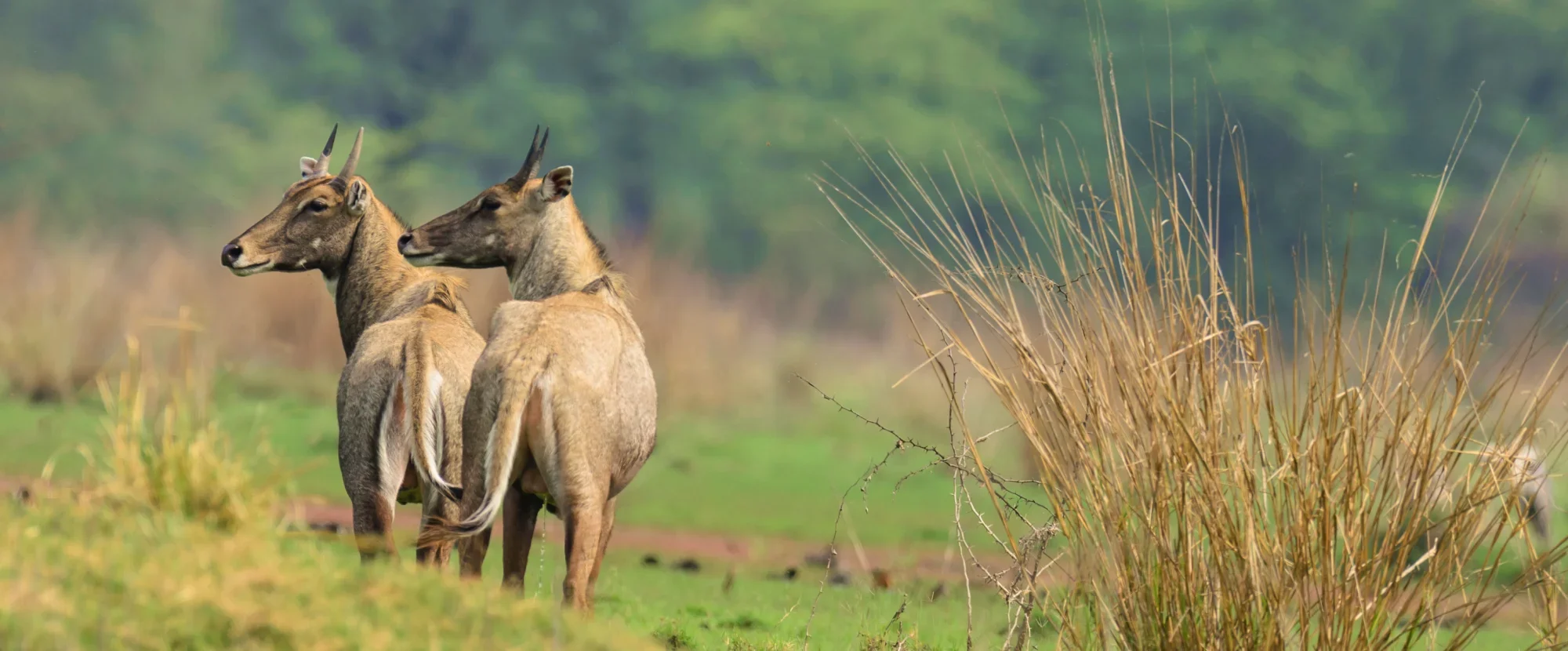
India is blessed with an incredible diversity of animal and bird life and, whilst human-made pressures remain, the country has worked hard to ensure that huge swathes of its landmass have been designated protected areas.
No more is this true than in central India which has a huge network of reserves and national parks, many of which interlink providing corridors for animals to roam freely. Another distinguishing feature of this region is the wide variety of landscapes, all of which further promote biodiversity in the wildlife. With forest and woodland, desert, scrub and semi-arid land, rivers, streams and wetlands, the range of wildlife is substantial with chital, sambar, barasingha, buffalo, nilgai, gaur, leopard, sloth bear, jackal and wild dog all present. However, the main draw is tiger and, with good amounts of prey present and an ideal habitat, numbers are increasing and sightings are good. This short itinerary includes two of India’s best national parks, Kanha and Bandhavgarh, with ample time spent in both and time either side in Delhi to see the capital’s main cultural sites.
Delhi – Kanha – Bandhavgarh – Delhi
Trip Highlights
- Forested Kanha is a beautiful reserve and one rich in wildlife including tiger and leopard
- Beautiful Bandhavgarh offers some of the very finest wildlife viewing in India
- Central India is synonymous with the Bengal tiger with good populations are found here
- There is excellent birdwatching in central India with hundreds of species recorded
- Hard to see in the wild, with luck elusive leopard can be seen in Kanha and Bandhavgarh
- Take a tour of Old Delhi, visiting Chandni Chowk markets, the Jama Masjid and Red Fort
Itinerary
Day 1
Depart the UK
Today depart the UK and fly to Delhi.
Please note that all national parks in Madhya Pradesh including Kanha and Bandhavgarh close on a Wednesday afternoon with reserves open between October and the end of June each season.
Day 2
Arrive Delhi
On arrival transfer to your hotel and, later, you will be joined by a local guide for an exploration of New Delhi. Highlights include Humayun’s Tomb, a UNESCO World Heritage Site built in 1570, the Qutb Minar complex with its impressive 13th century victory tower, India Gate, a memorial designed by Sir Edwin Lutyens and Rashtrapati Bhavan, the official residence of the President of India. End the day at the Gurdwara Bangla Sahib, a magnificent white-marble Sikh temple.
Haveli Dharampura
The Claridges New Delhi
The Imperial
Day 3
Delhi to Nagpur by air / Nagpur to Kanha – 290kms
This morning transfer back to Delhi Airport for the flight to Nagpur. On arrival you will be met and driven to Kanha National Park where you will stay for the next three nights. Widely considered to be one of the finest national parks in Asia, the meadows, streams and woodlands which punctuate the park support a diverse range of wildlife including tiger.
Shergarh Tented Camp
Kanha Earth Lodge
Bagh Villas
Day 4-5
Kanha National Park
Over the next two days explore the park on morning and evening exclusive jeep safaris with your naturalist. Kanha is home to a variety of wildlife which includes tiger, bison, leopard and jackal as well as a rich variety of birdlife with over 230 species recorded.
- Breakfast,
- Lunch,
- Dinner
Shergarh Tented Camp
Kanha Earth Lodge
Bagh Villas
Day 6
Kanha to Bandhavgarh – 280kms
This morning leave Kanha and continue by road to Bandhavgarh National Park. This attractive reserve is situated in the heart of the Vindhyachal mountain range. Mainly covered by sal and mixed forest, there are also areas of meadow and grassland as well as numerous small streams that meander through most areas of the reserve.
- Breakfast,
- Lunch,
- Dinner
Kings Lodge
Tree House Hideaway
Day 7-8
Bandhavgarh National Park
Explore Bandhavgarh over the next two days on morning and evening exclusive jeep safaris in the company of an expert naturalist. Bandhavgarh has one of the highest densities of tiger, leopard and sloth bear of any national park in India. Bandhavgarh also has rich and varied birdlife with hornbill, crested serpent eagle and variable hawk eagle among the many species that can be seen.
- Breakfast,
- Lunch,
- Dinner
Kings Lodge
Tree House Hideaway
Day 9
Bandhavgarh to Jabalpur – 190kms / Jabalpur to Delhi by air
This morning leave Bandhavgarh and drive to Jabalpur Airport for the afternoon flight to Delhi. On arrival you will be met and transferred to your hotel in the city. The remainder of the day will be at leisure.
- Breakfast
Haveli Dharampura
The Claridges New Delhi
The Imperial
Day 10
Delhi
Following breakfast head to Old Delhi for a morning guided tour. Explore the area’s dense network of bustling alleyways, homes, bazaars and mosques, visit the famous Chandni Chowk market, the beautiful Jama Masjid, the Red Fort and Rajghat which is where Mahatma Ghandi was cremated. Return to your hotel where for an afternoon at leisure.
- Breakfast
Haveli Dharampura
The Claridges New Delhi
The Imperial
Day 11
Delhi to the UK
Today transfer back to Delhi Airport and fly back to the UK.
- Breakfast
Extending your stay...
Lesser known than the region’s more famous national parks, Panna is a Project Tiger Reserve and a morning’s drive from Bandhavgarh. Largely covered in forest interspersed with streams, the reserve supports the rare gharial crocodile and over 200 different bird species.
Central India is blessed with a number of excellent wildlife reserves and Pench National Park is one of its finest. Dense forest, rivers and open grassland provide sanctuary to tiger, leopard, sloth bear and wild dog, sambar, nilgai, chital and gaur.
Satpura National Park occupies a beautiful hilly setting and is widely considered to have some of the subcontinent’s finest tiger habitat. The birdwatching at Satpura is also excellent with the vast Tawa reservoir attracting a whole host of different bird species.
Birdwatchers can include a visit to Keoladeo National Park which is one of the world’s leading bird sanctuaries. Located to the south of Delhi, the reserve is predominately marshland which provides sanctuary to over-wintering aquatic birds and resident Indian species.
Guide to Price
11 days from £3950 - £4450 per person
What's Included
- International and domestic flights
- Private car with English speaking driver
- Sightseeing with local English speaking guides
- Wildlife viewing with local naturalist
- Hotel accommodation and taxes
What's Not Included
- Cost of visas
- Travel Insurance
- Expenses of a personal nature
from £3950 - £4450
Travel Information
Getting There
British Airways fly direct from London Heathrow to Delhi, Mumbai, Bangalore, Chennai and Hyderabad. Virgin Atlantic have daily flights to Delhi and Vistara fly direct to Delhi. Emirates, Oman Air, Qatar Airways and Etihad Airways also have excellent connections via their respected hubs to Kolkata, Kochi, Trivandrum, Kozhikode, Goa, Jaipur and Lucknow and fly from airports all over the UK.
Flying Times From UK
Direct flights from the UK take between 8 and 10 hours depending on the destination. Flights with stops en-route take between 12 and 14 hours.
Time Zone
India is +5½ hours ahead of GMT.
Visa Requirements
Holders of British Citizen passports are able to apply for an e-Tourist Visa (eTV). There are three different eTVs - a one month eTV (valid for 30 days), a one year eTV (valid for 365 days) and a five year eTV (valid for 5 years). Applications for the one month eTV can only be made within 30 days of travel to India. Applications for the one year eTV and five year eTV can only be made within 120 days of travel to India.
Please note that the very latest an Indian eTV application can be made is 4 days prior to travel to India. The eTV becomes active from the date of entry into India. It is not valid for Protected or Restricted areas.
All international passengers arriving in India are required to complete an e-Arrival Card up to 72 hours prior to arrival India. This applies to all nationalities and must be submitted online via the official portal https://indianvisaonline.gov.in/earrival
Do’s & Don’ts
Smoking and drinking in public places is prohibited in India – with smoking this includes public areas in hotels, restaurants and bars.
E-cigarettes and related products are banned in India. You will be unable to buy e-cigarettes or bring them into the country.
Always ask permission before entering a temple and remember to remove your shoes and any leather objects such as bags, belts or wallets. It is fine to wear socks.
When in a Buddhist temple you should always walk in a clockwise direction with the main building to your right.
Modest, loose-fitting clothing is preferable and is essential when visiting religious places. When visiting a Sikh Gurudwara the head needs to be covered.
Permission should always be asked before taking a person’s picture.
When eating, only the right hand should be used. Indian culture considers the left hand to be unclean.
Money
The currency of India is the Indian Rupee (INR) and comes in notes and coins. Exchanging money is easy and can be done at international airports, most hotels or banks and it is always a good idea to ask for some small denomination Rupee notes. ATMs are now common and reliable in all main cities and credit cards are widely accepted by most hotels, shops and restaurants. In rural areas or wildlife reserves ATMs and money exchange facilities are limited so having cash is essential.
Please note that there are restrictions on bringing Indian rupees into India. Visitors, including tourists, are not permitted to bring any amount of Indian currency into the country. Pounds sterling and other foreign currencies are allowed to be brought into India. For more information please visit the FCO’s Foreign Travel Advice for India.
Tipping
This is left to your discretion, however, tipping for good service in India is part of everyday life. In restaurants and for room service a 10% tip is appreciated and at smaller hotels and homestays a communal ‘tip box’ is common.
For drivers and guides, hotel staff and at national parks, the following amounts should act as a guideline. Please note that these figures are based on two people travelling together:
Tour driver: INR1000 to INR1200 per day (not per person)
Tour guide: INR1000 to INR1200 per day (not per person)
Naturalist (national parks): INR1000 to INR1200 per day (not per person)
Jeep Driver (national parks): INR 500 per day & per safari (not per person)
Hotels (communal tip for all staff): INR 1000 to INR 1500 per day (not per person)
Food & Drink
India is known the world over for its food and especially its vegetarian cuisine. Spice plays an important role in dishes throughout the country as do breads, rice, pickles and chutneys. Although nearly every region has its own speciality, there is a divide between the cuisine of northern India and southern India – the north with its meat dishes influenced by the Mughals and the lighter, fruitier, coconut based dishes of the south. Desserts are common in India with kulfi ice cream and gulab jamun two of the best known and most popular. Nearly all tend to be very sweet, milk based or fried.
The most common drink in India is chai tea which can be bought on nearly every street corner. The yoghurt drink lassi – whether sweet, salty or fruity – is also easy to find. The popularity of coffee has spread from the south whilst Indian beer is well-respected. There is also a fledgling wine industry centred on Nashik in Maharashtra.
Accommodation
There is a huge breadth of accommodation in India with styles varying across the country. India is famed for its heritage properties, the majority of which tend to be found in the north of India. These come in all shapes and sizes from beautifully restored buildings and luxury palaces operated by distinguished hotel groups to small privately owned forts and ancestral homes.
Homestays are also very popular and found throughout the country. Whether a grand and luxurious family residence, heritage property or simple abode, they offer a high level of service and a unique glimpse into everyday Indian life. Please let us know if you would like to include a homestay into your itinerary. In more remote regions, hotels are likely to be clean and simple whilst wildlife accommodation is generally either in jungle lodges or comfortable tented camps. For those looking to relax there are many excellent beachside hotels and an increasing number of retreats specialising in both Ayurveda and yoga.
Shopping
With wholesale markets and bazaars, innumerable shops and stores, India is a shopper’s paradise. The country is best known for carpets and dhurries with Rajasthan, Kashmir and Leh best for these. There is also a bewildering range of clothing, fabric and leatherwear found not only in the smallest of villages but also the largest cities. Gems, silver and jewellery (valuable or costume) are popular throughout the country but especially in Jaipur and Hyderabad whilst Kochi is noted for its antiques. Spices can be bought all over India but purchased straight from plantations in the south. Darjeeling, Assam and the Western Ghats in south India are all known for tea.
Suggested Reading
For India travel advice, Footprint, Rough Guides, Lonely Planet and Bradt have excellent guide books whilst Nelles Maps have comprehensive and up to date maps of the Indian subcontinent. There is also a wide range of literature including from famed authors such as RK Narayan, Vikram Seth, Paul Scott, VS Naipaul, Arundhati Roy and Salman Rushdie. Vivek Shanbhag's more recently translated book 'Ghachar Ghochar' also comes highly recommended. Other good books on India include:
‘India: A History’ by John Keay
‘The Great Arc’ by John Keay
‘No Full Stops in India’ by Mark Tully
‘India in Slow Motion’ by Mark Tully and Gillian Wright
‘City of Djinns’ by William Dalrymple
‘White Mughals’ by William Dalrymple
‘Chasing the Monsoon’ by Alexander Frater
‘The Tears of the Rajas’ by Ferdinand Mount
‘Plain Tales from the Raj’ by Charles Allen
‘Mughal Architecture and Gardens’ by George Michell
'Tea, Love and War: Searching for English Roots in Assam' by David Mitchell
Health
Your doctor is the best person to advise you on staying healthy whilst abroad but current recommended vaccinations are Hepatitis A, Typhoid, Tetanus and Diphtheria. Yellow Fever is compulsory, but only if you have visited an affected Yellow Fever area within 5 days prior to your arrival. In some instances anti-malarial tablets may also be needed. For current information on health advice you may wish to visit the National Travel Health Network and Centre (NaTHNaC) website Travel Health Pro on https://travelhealthpro.org.uk/. The Medical Advisory Services for Travellers Abroad (MASTA) website (www.masta.org) is also a useful resource.
Travel Advice
For current information on India the best resource is the Foreign and Commonwealth Office (www.gov.uk/foreign-travel-advice) which is a comprehensive resource and updated regularly. We would also recommend visiting the Safer Tourism Foundation website (safertourism.org.uk) before you travel and will be happy to address any questions or concerns you may have.


Looking for something more bespoke?
Our India travel consultants can help you create your perfect trip
- Experts in tailor-made holidays
- Honest pricing with no hidden extras
- ABTA and ATOL protected


Our Reviews
What our clients say
All in all a super special holiday
MR & RR - India - March 2024
All in all a super special holiday. Thanks so much for helping to put it together. The guides and drivers are always so important and they were excellent and kind throughout. Assam and Nagaland are so different from mainland India...a very relaxed vibe in beautiful surroundings. We would happily return.


Getting to know you
A crucial part of our process, discuss your plans with us either by phone, video or in person.
Helping you to design your trip
Entirely tailor-made, there is complete flexibility to incorporate all your requirements.
On-hand support, when you need it
Our team are on hand to answer any questions and ensure you are fully ready, and excited, for your trip.
Full confidence whilst you are away
Enjoy full support from our UK team and trusted local partners throughout your journey.
We’re pleased to confirm that Pettitts Travel will not apply any surcharges to our package holidays when we are operating as a tour operator, regardless of changes in global costs. The price you agree at the time of booking is the price you will pay, a commitment we have proudly upheld for the past 38 years.


