


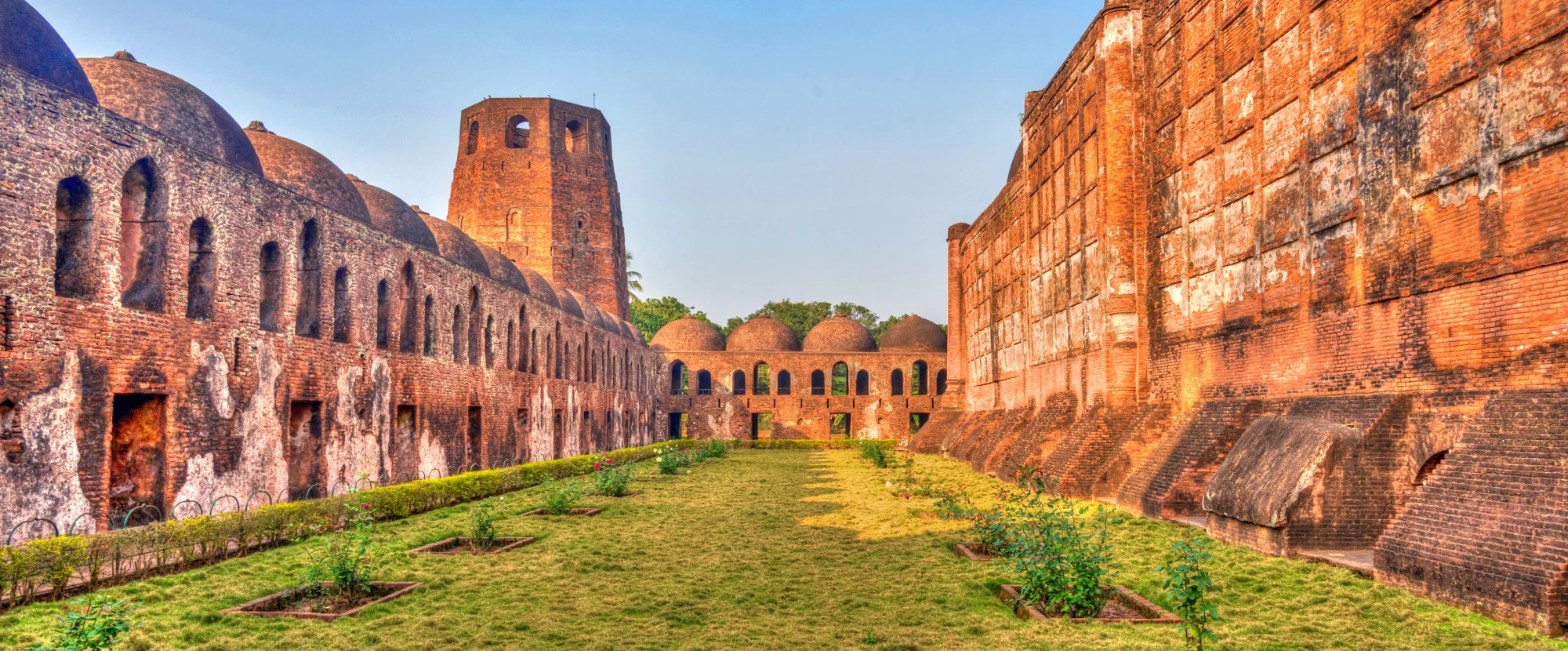
Bengal has long been recognised as a bastion of arts, culture and commerce, a melting pot of peoples, traditions and ideas proudly distinct to the rest of India.
This was the primary region that first encountered permanent European settlement on Indian soil, gave birth to such luminaries as Rabindranath Tagore and was the cradle of the Indian independence movement. This itinerary explores the best of the Indian state of West Bengal from the better-known European settlements that line the Hooghly River to the lesser visited Bengali towns of the interior. Starting with two full days to explore Kolkata follow the river north to visiting French Chandernagore, Dutch Chinsura and Danish Serampore before heading inland to Bishnupur with its extraordinary collection of terracotta temples. From Bishnupur head to Shantiniketan, a town and university established by Tagore to both mould and champion Bengali culture, before continuing on to the temple town of Tarapith. End your journey with three nights back on the Hooghly in Azimganj where day visits will be made to magnificent Murshidabad and the former Dutch colony of Cossimbazar.
Kolkata – Chandernagore – Chinsura – Serampore – Bishnupur – Shantiniketan – Tarapith –Azimganj – Murshidabad – Cossimbazar – Kolkata
Trip Highlights
- See Bishnupur’s extraordinary terracotta temples, adorned with decorative carvings
- Established by Tagore in 1901, Shantiniketan remains a bastion of Bengali culture
- The Tantric Temple in Tarapith is a pilgrimage centre and home to the Aghori sadhus
- Visit Panchmura where artisans continue the practice of terracotta pottery throwing
- Discover the churches, convents and homes of former French colony of Chandernagore
- In Murshidabad visit the Hazarduari Palace, Nizamat Imambara and Katra Masjid
- Follow the Hooghly south to the former Dutch colony of Cossimbazar, once one of the most important ports on the river
Itinerary
Day 1
Depart the UK
Fly from the UK to Kolkata via the Middle East.
Day 2
Arrive Kolkata
Arrive in Kolkata. Here you will be met and transferred to your hotel for a three-night stay. Both the capital and largest city in West Bengal, Kolkata is a bastion of Bengali culture, revered for the role it played in Indian independence and the birthplace to many of India’s greatest thinkers, writers, artists and poets. Capital of British India until 1911, today Kolkata remains a commercial centre.
- Breakfast
Calcutta Bungalow
The Elgin Fairlawn
Oberoi Grand Hotel
Lorem Ipsum is simply dummy text of the printing and typesetting industry. Lorem Ipsum has been the industry's standard dummy text ever since the 1500s, when an unknown printer took a galley of type and scrambled it to make a type specimen book. It has survived not only five centuries
Day 3
Kolkata
In the company of your guide, today discover Kolkata like a local, exploring on foot and using public transport including the city’s metro, the first in India, local taxis and rickshaw. Highlights today include the potter’s quarter at Kumartuli where artisans create giant life-like religious idols out of clay, Rabindranath Tagore’s home where the famous poet and writer was born, the excellent Indian Museum, marble-clad Victoria memorial and the Kalighat Kali Temple.
- Breakfast
Calcutta Bungalow
The Elgin Fairlawn
Oberoi Grand Hotel
Lorem Ipsum is simply dummy text of the printing and typesetting industry. Lorem Ipsum has been the industry's standard dummy text ever since the 1500s, when an unknown printer took a galley of type and scrambled it to make a type specimen book. It has survived not only five centuries
Day 4
Kolkata
Take a heritage walk today through the heart of historic Kolkata. This district is famed for its grand Raj-era architecture and some of the buildings you will see this morning include Governor’s House, the Treasury Building, St John’s Church, the General Post Office and Writer’s Building. Stops will also be made at St Andrew’s Church, the Currency Building and Central Telegraph Office, ending at the Great Eastern Hotel. Established in 1841, the hotel has played host to numerous luminaries over the years and was referred to by Mark Twain as ‘the best hotel East of Suez’.
- Breakfast
Calcutta Bungalow
The Elgin Fairlawn
Oberoi Grand Hotel
Lorem Ipsum is simply dummy text of the printing and typesetting industry. Lorem Ipsum has been the industry's standard dummy text ever since the 1500s, when an unknown printer took a galley of type and scrambled it to make a type specimen book. It has survived not only five centuries
Day 5
Kolkata to Serampore via Chandernagore and Chinsura – 90kms
After breakfast leave Kolkata for today’s journey to Serampore with stops on the way in Chandernagore and Chinsura. Set on the banks of the Hooghly, Chandernagore was a colony of France until 1950 and retains many of its churches, convents and typically French homes. Here visit the Sacred Heart Church and the home of Joseph François Dupleix, the Governor-General of French India. From Chandernagore make a brief stop in the Dutch town of Chinsura then continue to Serampore for a two-night stay.
- Breakfast
Denmark Tavern by The Park
Day 6
Serampore
The Danish colony of Serampore, when established, was known as Frederiknagore, after the Danish monarch and, like the other European enclaves of this region is set beside the Hooghly River. Purchased by the East India Company in 1845, Serampore became known for its printing presses and today see the town’s churches, temples, colonial administrative buildings and the manuscript collection at Serampore College.
- Breakfast
Denmark Tavern by The Park
Day 7
Serampore to Bishnupur – 125kms
This morning head inland from the river to Bishnupur where you will stay overnight. Bishnupur is known for its collection of terracotta temples and this afternoon visit a selection of these with your guide. Constructed by the Malla kings between the 10th and 17th centuries and dedicated to Lord Vishnu, the temples not only reflect the unique architectural styles of Bengal but the carvings which adorn them drew inspiration from Bengali poets and artists. Highlights include the Rasmancha temple with its unusual turrets and the flat-roofed Madanmohan temple.
- Breakfast
Hotel Annapurna
Day 8
Bishnupur to Shantiniketan via Panchmura – 165kms
After breakfast leave Bishnupur and drive to Panchmura where artisans continue the age-old practice of terracotta pottery throwing. As with many art forms, the potters of Panchmura originally drew inspiration from religion, however, today they produce a range of different work. From Panchmura continue to Shantiniketan, founded as an experimental school in 1901 by Rabindranath Tagore. Created as a centre for Bengali drawing inspiration from ancient, medieval and folk traditions from across Asia, Shantiniketan continues to attract intellectuals, teachers, artists and craftspeople.
- Breakfast
Udichi Residency
The Creek Boutique Resort
Day 9
Shantiniketan
Today explore Shantiniketan and the campus of Vishwa Bharati University, established by Tagore in 1921. With open-air classrooms, sculptures and paintings, terracotta work and buildings adorned with murals, the campus has an unmistakable Bengali character.
- Breakfast
Udichi Residency
The Creek Boutique Resort
Day 10
Shantiniketan to Tarapith – 65kms
Leave Shantiniketan this morning and drive north to the temple town of Tarapith. Upon arrival visit the Tantric temple, entering the precinct with devotees, pilgrims and holy men. Tarapith’s cremation grounds, adjacent to the temple, are home to the Aghori sadhus, a tantric order that are followers of Shiva.
- Breakfast
Hotel Sonar Bangla
Day 11
Tarapith to Azimganj – 75kms
This morning cross country to Azimganj where you will stay for the next three nights at Bari Kothi, a restored 18th century residence. Later this afternoon leave your hotel for a heritage walk to discover some of the Azimganj’s palaces and temples.
- Breakfast,
- Lunch,
- Dinner
Bari Kothi
Day 12
Azimganj – visit Murshidabad
After breakfast visit Murshidabad. Befitting at town that was not only the capital of the Nawabs of Bengal but also a wealthy British trading centre, Murshidabad is graced with a dazzling collection of mosques and mansion, tombs and palaces. Highlights of your visit today will include Hazarduari Palace, Nizamat Imambara, the huge Jahankosha canon, the 18th century Katra Masjid and Khoshbagh, the garden-cemetery of the Nawabs.
- Breakfast,
- Lunch,
- Dinner
Bari Kothi
Day 13
Azimganj – visit Cossimbazar
Today follow the Hooghly south to the former Dutch colony of Cossimbazar. Once one of the most important ports on the river, Cossimbazar grew wealthy through the trade of silk, hosiery and ivory with the English, Dutch and French all having factories in the town. Take a walk in the town and visit the grand Cossimbazar Rajbari which houses an interesting museum. Later return to Azimganj where the remainder of your day will be at leisure.
- Breakfast,
- Lunch,
- Dinner
Bari Kothi
Day 14
Azimganj to Kolkata – by train
After breakfast you will be transferred to Azimganj Railway Station for the train back to Kolkata arriving in the afternoon. Once in Kolkata you will be met and taken to your hotel in the city where you will stay overnight.
- Breakfast
Calcutta Bungalow
The Elgin Fairlawn
Oberoi Grand Hotel
Lorem Ipsum is simply dummy text of the printing and typesetting industry. Lorem Ipsum has been the industry's standard dummy text ever since the 1500s, when an unknown printer took a galley of type and scrambled it to make a type specimen book. It has survived not only five centuries
Day 15
Kolkata to the UK
Transfer to Kolkata Airport for the flight back to the UK via the Middle East.
- Breakfast
Extending your stay...
Discover Belgadia Palace, a two-hundred-year-old Victorian palace in rural Odisha just over the border from West Bengal. Attend the weekly village market, or haat, visit a ruined medieval fort, learn about dokra, intricate metalworking, art or birdwatch in the palace grounds.
Include the temples of Bhubaneshwar, Konark and Puri reached either by road from Belgadia Palace or by train or flight from Kolkata. Bhubaneshwar is a temple city, there are over 700 here, Konark is the site of the remarkable Sun Temple and Puri setting for the Jaganath Temple.
Fly east from Kolkata to Lucknow a city with a rich cultural heritage as well as a magnificent collection of royal Imambaras, palaces, shrines and mosques. Lucknow also played a key role in India’s independence struggle or which the ruins of the Residency complex are testament.
Darjeeling is a historic Raj-era hill station set amongst magnificent natural scenery. Stay outside of the town on a historic tea estate to walk and birdwatch and take a ride on the famous Darjeeling Mountain Railway to the Yiga-Choling Monastery near Ghoom.
Guide to Price
15 days from £4300 - £4700 per person
What's Included
- International flights
- Private car with English speaking driver
- Sightseeing with local English speaking guides
- Hotel accommodation and taxes
What's Not Included
- Cost of visas
- Travel Insurance
- Expenses of a personal nature
from £4300 - £4700
Travel Information
Getting There
British Airways fly direct from London Heathrow to Delhi, Mumbai, Bangalore, Chennai and Hyderabad. Virgin Atlantic have daily flights to Delhi and Vistara fly direct to Delhi. Emirates, Oman Air, Qatar Airways and Etihad Airways also have excellent connections via their respected hubs to Kolkata, Kochi, Trivandrum, Kozhikode, Goa, Jaipur and Lucknow and fly from airports all over the UK.
Flying Times From UK
Direct flights from the UK take between 8 and 10 hours depending on the destination. Flights with stops en-route take between 12 and 14 hours.
Time Zone
India is +5½ hours ahead of GMT.
Visa Requirements
Holders of British Citizen passports are able to apply for an e-Tourist Visa (eTV). There are three different eTVs - a one month eTV (valid for 30 days), a one year eTV (valid for 365 days) and a five year eTV (valid for 5 years). Applications for the one month eTV can only be made within 30 days of travel to India. Applications for the one year eTV and five year eTV can only be made within 120 days of travel to India.
Please note that the very latest an Indian eTV application can be made is 4 days prior to travel to India. The eTV becomes active from the date of entry into India. It is not valid for Protected or Restricted areas.
All international passengers arriving in India are required to complete an e-Arrival Card up to 72 hours prior to arrival India. This applies to all nationalities and must be submitted online via the official portal https://indianvisaonline.gov.in/earrival
Do’s & Don’ts
Smoking and drinking in public places is prohibited in India – with smoking this includes public areas in hotels, restaurants and bars.
E-cigarettes and related products are banned in India. You will be unable to buy e-cigarettes or bring them into the country.
Always ask permission before entering a temple and remember to remove your shoes and any leather objects such as bags, belts or wallets. It is fine to wear socks.
When in a Buddhist temple you should always walk in a clockwise direction with the main building to your right.
Modest, loose-fitting clothing is preferable and is essential when visiting religious places. When visiting a Sikh Gurudwara the head needs to be covered.
Permission should always be asked before taking a person’s picture.
When eating, only the right hand should be used. Indian culture considers the left hand to be unclean.
Money
The currency of India is the Indian Rupee (INR) and comes in notes and coins. Exchanging money is easy and can be done at international airports, most hotels or banks and it is always a good idea to ask for some small denomination Rupee notes. ATMs are now common and reliable in all main cities and credit cards are widely accepted by most hotels, shops and restaurants. In rural areas or wildlife reserves ATMs and money exchange facilities are limited so having cash is essential.
Please note that there are restrictions on bringing Indian rupees into India. Visitors, including tourists, are not permitted to bring any amount of Indian currency into the country. Pounds sterling and other foreign currencies are allowed to be brought into India. For more information please visit the FCO’s Foreign Travel Advice for India.
Tipping
This is left to your discretion, however, tipping for good service in India is part of everyday life. In restaurants and for room service a 10% tip is appreciated and at smaller hotels and homestays a communal ‘tip box’ is common.
For drivers and guides, hotel staff and at national parks, the following amounts should act as a guideline. Please note that these figures are based on two people travelling together:
Tour driver: INR1000 to INR1200 per day (not per person)
Tour guide: INR1000 to INR1200 per day (not per person)
Naturalist (national parks): INR1000 to INR1200 per day (not per person)
Jeep Driver (national parks): INR 500 per day & per safari (not per person)
Hotels (communal tip for all staff): INR 1000 to INR 1500 per day (not per person)
Food & Drink
India is known the world over for its food and especially its vegetarian cuisine. Spice plays an important role in dishes throughout the country as do breads, rice, pickles and chutneys. Although nearly every region has its own speciality, there is a divide between the cuisine of northern India and southern India – the north with its meat dishes influenced by the Mughals and the lighter, fruitier, coconut based dishes of the south. Desserts are common in India with kulfi ice cream and gulab jamun two of the best known and most popular. Nearly all tend to be very sweet, milk based or fried.
The most common drink in India is chai tea which can be bought on nearly every street corner. The yoghurt drink lassi – whether sweet, salty or fruity – is also easy to find. The popularity of coffee has spread from the south whilst Indian beer is well-respected. There is also a fledgling wine industry centred on Nashik in Maharashtra.
Accommodation
There is a huge breadth of accommodation in India with styles varying across the country. India is famed for its heritage properties, the majority of which tend to be found in the north of India. These come in all shapes and sizes from beautifully restored buildings and luxury palaces operated by distinguished hotel groups to small privately owned forts and ancestral homes.
Homestays are also very popular and found throughout the country. Whether a grand and luxurious family residence, heritage property or simple abode, they offer a high level of service and a unique glimpse into everyday Indian life. Please let us know if you would like to include a homestay into your itinerary. In more remote regions, hotels are likely to be clean and simple whilst wildlife accommodation is generally either in jungle lodges or comfortable tented camps. For those looking to relax there are many excellent beachside hotels and an increasing number of retreats specialising in both Ayurveda and yoga.
Shopping
With wholesale markets and bazaars, innumerable shops and stores, India is a shopper’s paradise. The country is best known for carpets and dhurries with Rajasthan, Kashmir and Leh best for these. There is also a bewildering range of clothing, fabric and leatherwear found not only in the smallest of villages but also the largest cities. Gems, silver and jewellery (valuable or costume) are popular throughout the country but especially in Jaipur and Hyderabad whilst Kochi is noted for its antiques. Spices can be bought all over India but purchased straight from plantations in the south. Darjeeling, Assam and the Western Ghats in south India are all known for tea.
Suggested Reading
For India travel advice, Footprint, Rough Guides, Lonely Planet and Bradt have excellent guide books whilst Nelles Maps have comprehensive and up to date maps of the Indian subcontinent. There is also a wide range of literature including from famed authors such as RK Narayan, Vikram Seth, Paul Scott, VS Naipaul, Arundhati Roy and Salman Rushdie. Vivek Shanbhag's more recently translated book 'Ghachar Ghochar' also comes highly recommended. Other good books on India include:
‘India: A History’ by John Keay
‘The Great Arc’ by John Keay
‘No Full Stops in India’ by Mark Tully
‘India in Slow Motion’ by Mark Tully and Gillian Wright
‘City of Djinns’ by William Dalrymple
‘White Mughals’ by William Dalrymple
‘Chasing the Monsoon’ by Alexander Frater
‘The Tears of the Rajas’ by Ferdinand Mount
‘Plain Tales from the Raj’ by Charles Allen
‘Mughal Architecture and Gardens’ by George Michell
'Tea, Love and War: Searching for English Roots in Assam' by David Mitchell
Health
Your doctor is the best person to advise you on staying healthy whilst abroad but current recommended vaccinations are Hepatitis A, Typhoid, Tetanus and Diphtheria. Yellow Fever is compulsory, but only if you have visited an affected Yellow Fever area within 5 days prior to your arrival. In some instances anti-malarial tablets may also be needed. For current information on health advice you may wish to visit the National Travel Health Network and Centre (NaTHNaC) website Travel Health Pro on https://travelhealthpro.org.uk/. The Medical Advisory Services for Travellers Abroad (MASTA) website (www.masta.org) is also a useful resource.
Travel Advice
For current information on India the best resource is the Foreign and Commonwealth Office (www.gov.uk/foreign-travel-advice) which is a comprehensive resource and updated regularly. We would also recommend visiting the Safer Tourism Foundation website (safertourism.org.uk) before you travel and will be happy to address any questions or concerns you may have.


Looking for something more bespoke?
Our India travel consultants can help you create your perfect trip
- Experts in tailor-made holidays
- Honest pricing with no hidden extras
- ABTA and ATOL protected


Our Reviews
What our clients say
All in all a super special holiday
MR & RR - India - March 2024
All in all a super special holiday. Thanks so much for helping to put it together. The guides and drivers are always so important and they were excellent and kind throughout. Assam and Nagaland are so different from mainland India...a very relaxed vibe in beautiful surroundings. We would happily return.


Getting to know you
A crucial part of our process, discuss your plans with us either by phone, video or in person.
Helping you to design your trip
Entirely tailor-made, there is complete flexibility to incorporate all your requirements.
On-hand support, when you need it
Our team are on hand to answer any questions and ensure you are fully ready, and excited, for your trip.
Full confidence whilst you are away
Enjoy full support from our UK team and trusted local partners throughout your journey.
We’re pleased to confirm that Pettitts Travel will not apply any surcharges to our package holidays when we are operating as a tour operator, regardless of changes in global costs. The price you agree at the time of booking is the price you will pay, a commitment we have proudly upheld for the past 38 years.


