



Leila Pullen - November 2nd, 2026
To help travellers plan an unforgettable tiger safari, Pettitts Travel has identified the top regions, tiger reserves and national parks in India and Nepal where tiger numbers are rising fastest.
We compiled the number of tigers recorded by the NTCA and NTNC in their last tiger status reports, per region, reserve and national park (last three for India and last four for Nepal). These numbers were then used to forecast tiger counts and density for 2030 and we ranked them by percentage growth to find the best areas to spot a tiger.
Where to See a Tiger in India
India possesses a special appeal as a destination for travellers drawn to the wildlife wonders of the world.
While the country is home to Asian elephants, Indian rhinoceros and Asiatic lions, the animal that has long captured the attention of safari lovers is the formidable tiger.
Home to roughly three-quarters of the world’s wild tiger population, India offers an unrivalled opportunity to encounter the Bengal tiger – the national animal and one of the largest subspecies of tiger on the planet.
With 58 tiger reserves as of 2026 and a wild tiger population that has more than doubled since 2006 to over 3,500, India is one of conservation’s great success stories.
For lovers of wildlife and culture alike, our tailor-made, luxury India holidays and tours provide a wealth of unforgettable experiences.
Regions in India with the Largest Tiger Population Growth
As the seventh-largest country in the world, spanning 28 states, India offers a vast and varied landscape in which to seek out the tiger.
To help you focus your search, we’ve identified the states where tiger numbers are growing fastest.
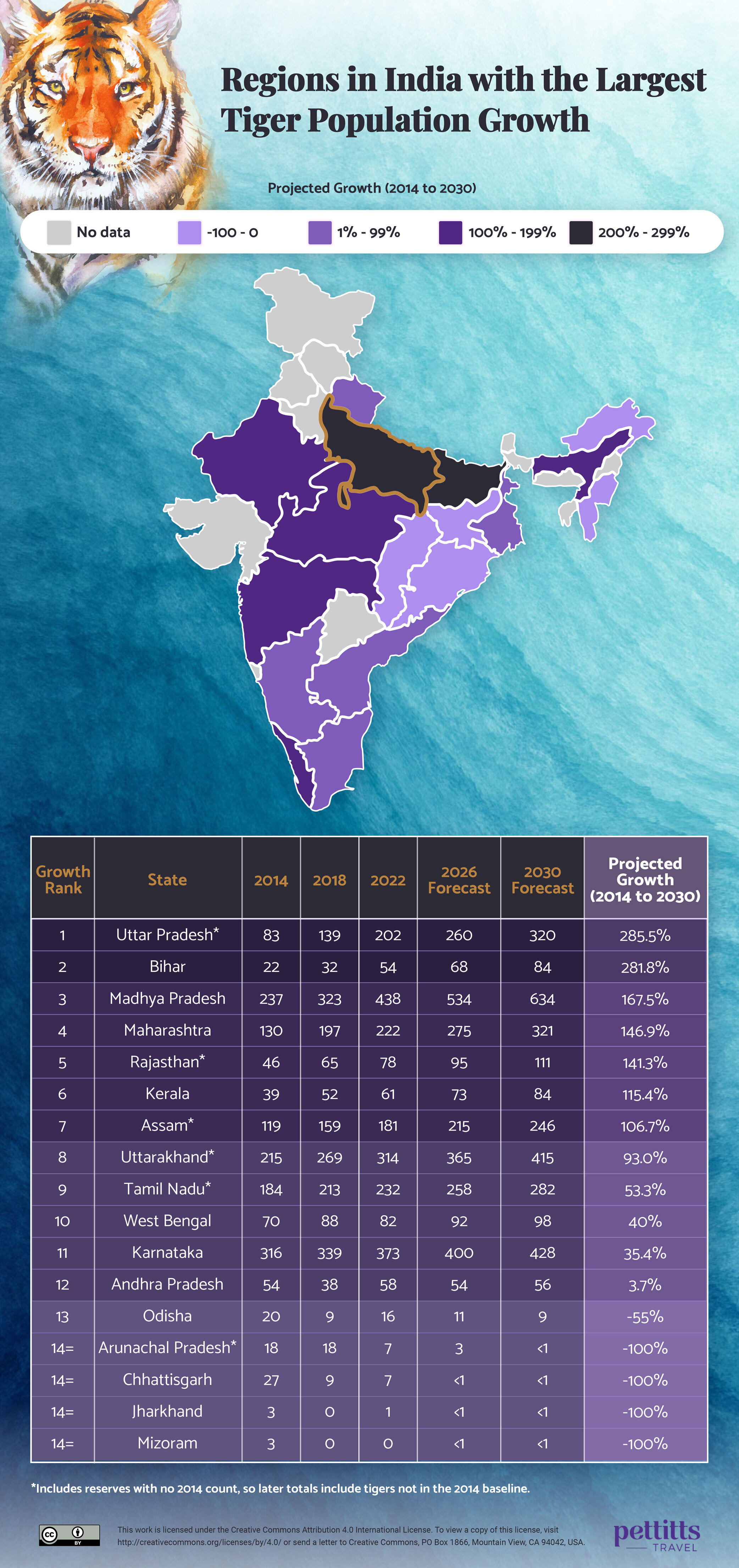
1 Uttar Pradesh
Home to the Taj Mahal, India’s most populous state, Uttar Pradesh has the highest projected growth rate for tigers in reserves. Tiger numbers here are forecast to rise by 286%, from 83 in 2014 to 320 by 2030.
Uttar Pradesh is home to four tiger reserves: Dudhwa Tiger Reserve, Pilibhit Tiger Reserve, Amangarh Tiger Reserve and Ranipur Tiger Reserve. Ranipur is the most recent addition, established in 2022.
For travellers seeking both wildlife and culture, our luxury Taj Mahal and Tigers tour brings together two of North India’s most iconic experiences.
2 Bihar
Following closely behind, the eastern state of Bihar ranks second for tiger population growth, with numbers expected to rise by 282% between 2014 and 2030.
This growth is concentrated in Bihar’s only tiger reserve, Valmiki Tiger Reserve, nestled at the foot of the Himalayas, where tiger numbers are projected to climb from 22 in 2014 to 84 by 2030.
3 Madhya Pradesh
Known as India’s ‘Tiger State’, Madhya Pradesh ranks third for tiger population growth but is home to more tigers than any other state.
Its reserves recorded 438 tigers in the latest 2022 census, with numbers projected to reach 634 by 2030 – a 168% increase on the 237 recorded in 2014.
Madhya Pradesh also has nine tiger reserves – more than any other state. The largest of these is Veerangana Durgavati, spanning 2,339 km2 of striking valleys, rivers, hills and grasslands.
Three of Madhya Pradesh’s reserves – Veerangana Durgavati, Ratapani and Madhav – were established from 2023 and have been excluded from the study.
India’s Top 5 Reserves with the Largest Tiger Population Growth
To have the best chance of catching a glimpse of the majestic Bengal tiger, you need to know when and where to go.
The best time to go on a tiger safari in India is generally between October and May, when the weather is dry and the foliage thins, making it easier to spot camouflaged tigers.
But where are tiger numbers rising fastest? We’ve listed the reserves with the highest tiger population growth so you can plan your perfect luxury wildlife holiday in India.
1 Manas Tiger Reserve
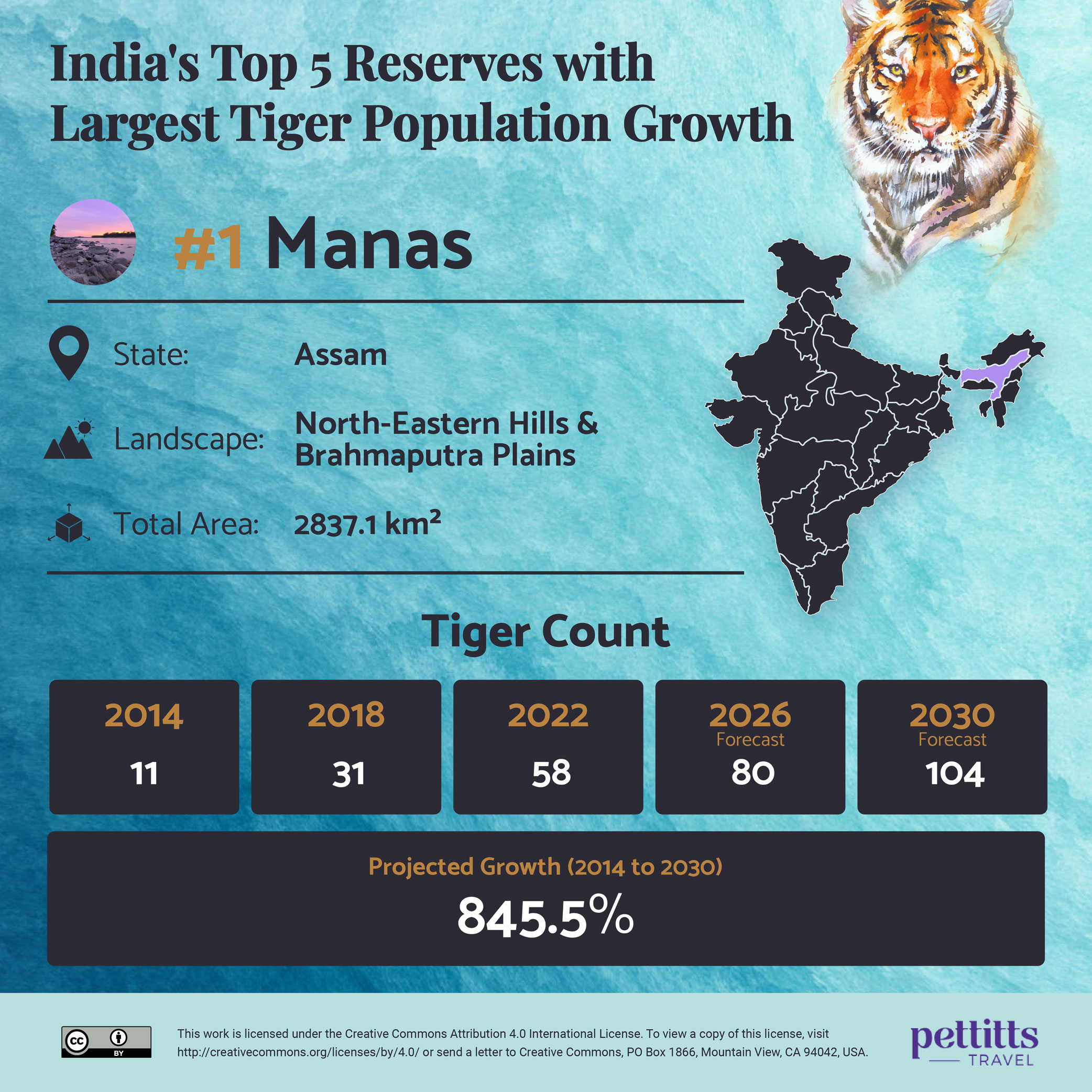
A UNESCO World Heritage Site, Manas Tiger Reserve is one of the largest tiger reserves in India. Its tiger population is forecast to grow by 845% between 2014 and 2030.
The reserve spans 2,837 km2 across the lush Brahmaputra plains at the base of the Eastern Himalayas. Manas offers the opportunity to spot one of the 58 Bengal tigers recorded here in 2022, alongside other remarkable species such as wild buffalo and clouded leopards.
Manas lies in Assam, a vibrant north-eastern state filled with tea gardens and wide river plains.
With Pettitts, you can discover the region’s culture and wildlife on our Journey through Assam tour, or sail one of Asia’s mightiest rivers aboard our Ultimate Brahmaputra River Cruise.
2 Kali Tiger Reserve
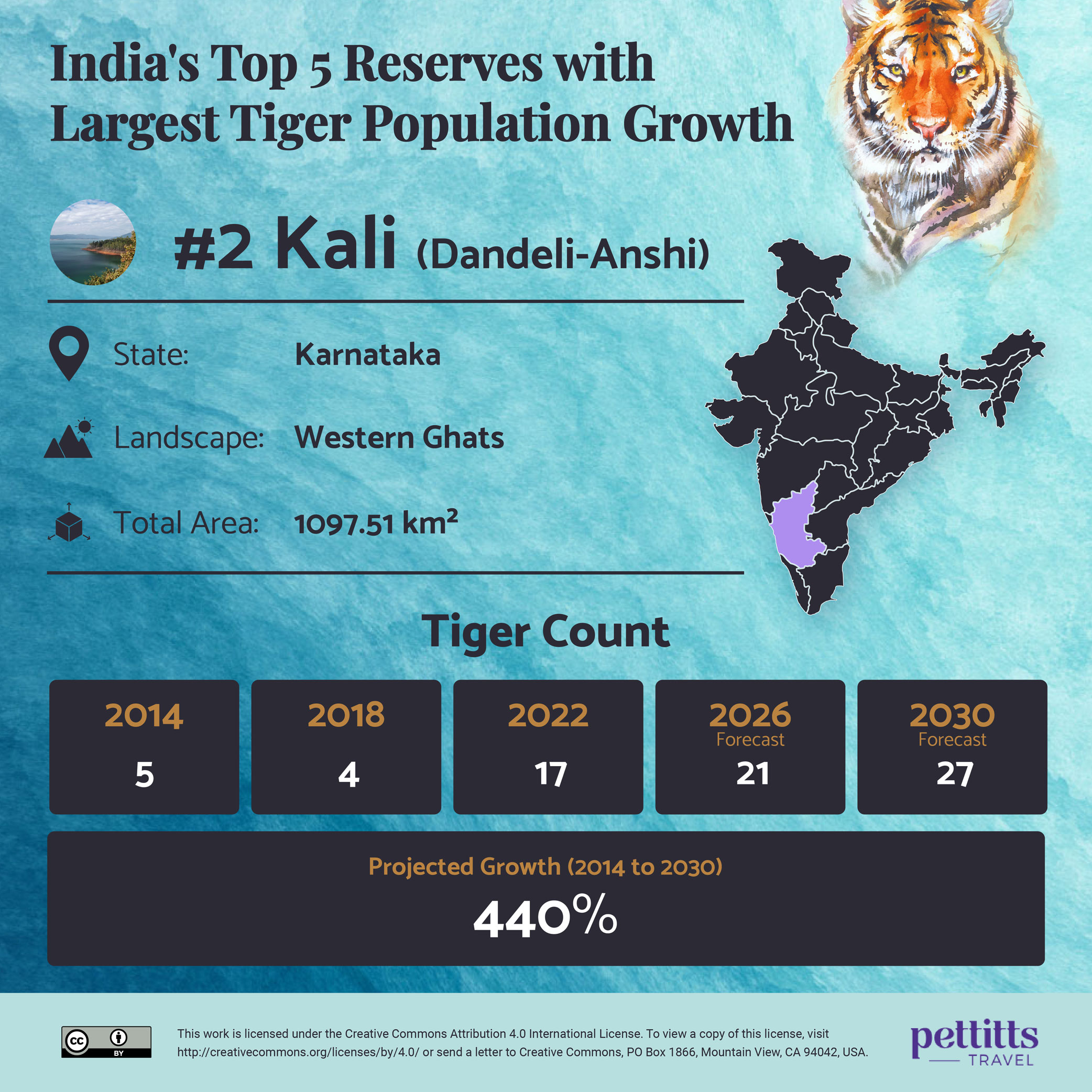
Kali Tiger Reserve has the second-largest tiger population growth in India, with numbers projected to rise by 440% between 2014 and 2030.
Located in Karnataka, the reserve combines Dandeli Wildlife Sanctuary and Anshi National Park. It offers a choice of nature camp stays for a peaceful and immersive trip in a stunning natural setting in south-west India.
The Kali River winds through this beautiful reserve and its forests stretch through the Western Ghats mountain range.
3 Panna Tiger Reserve
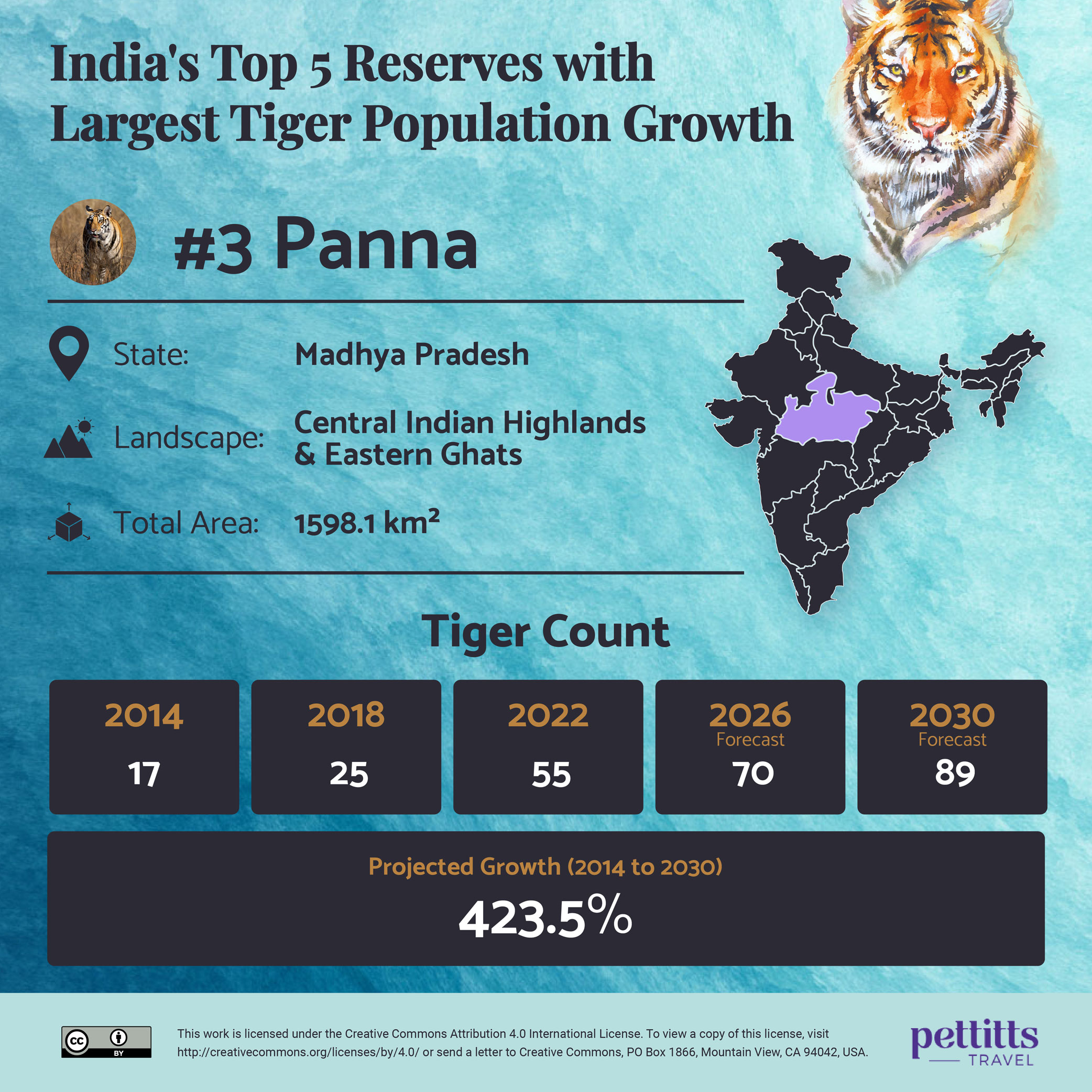
In the heart of India, Panna Tiger Reserve is one of Madhya Pradesh’s nine reserves and has the third-largest tiger population growth in India.
The reserve offers a choice of general safaris or tiger-specific packages to improve your chances of seeing the magical big cat.
It spans 1,598 km2 across the Vindhya Range, featuring the Ken River, tropical deciduous forests and nearby waterfalls and temples to marvel at.
The latest 2022 census recorded 55 tigers in the reserve, up from 17 in 2014, with numbers projected to rise by 424% between 2014 and 2030.
Explore Panna and the other wildlife parks of Central India on our Land of the Tiger journey.
4 Pilibhit Tiger Reserve
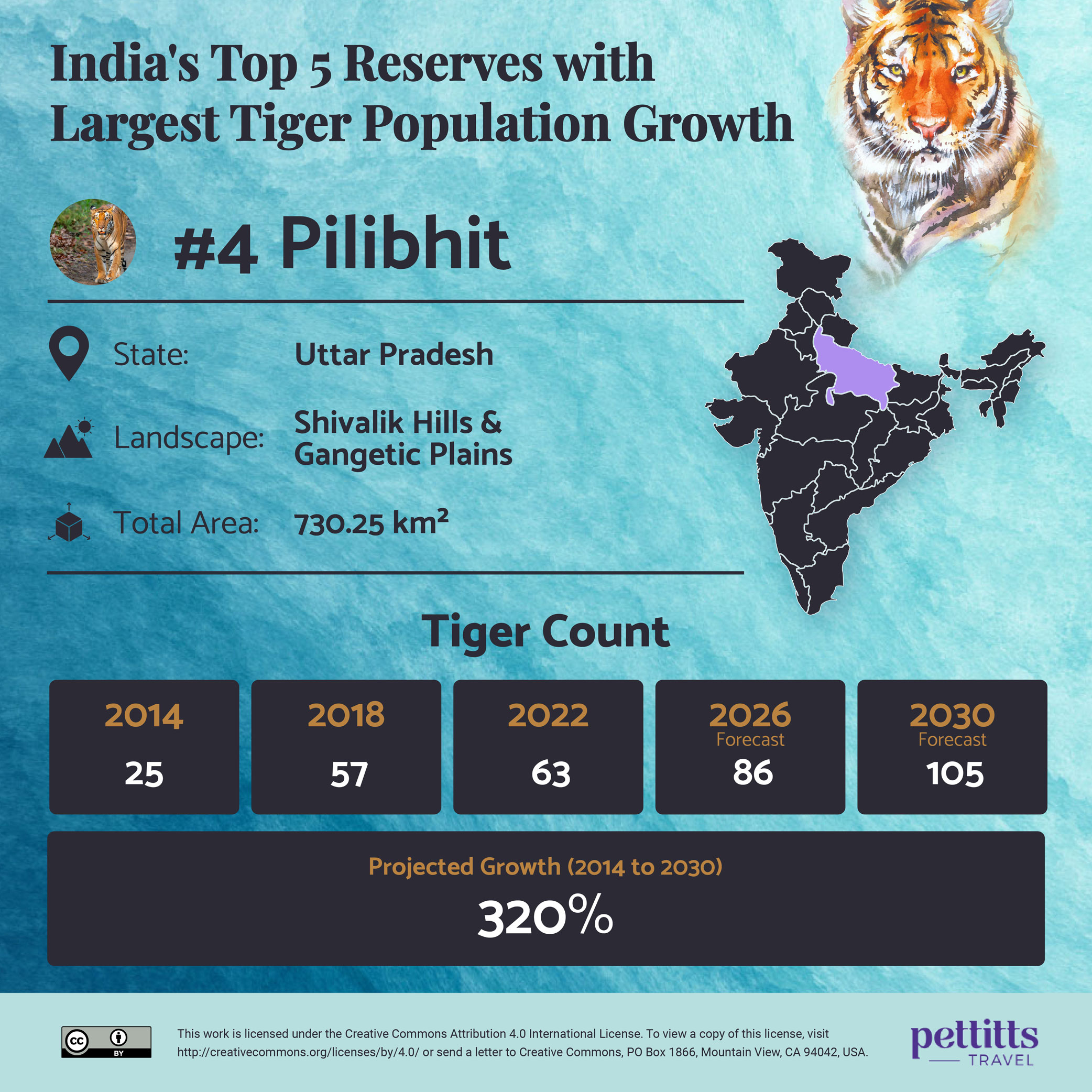
Located in Uttar Pradesh, Pilibhit Tiger Reserve has the fourth-largest tiger population growth in India, with numbers projected to rise by 320%, from 25 in 2014 to 105 by 2030.
Its diverse ecosystems of forests, meadows, swamps and rivers are spread across 730 km2.
Set in the north of the state amid the picturesque Shivalik Hills and Gangetic Plains, the reserve offers morning, afternoon and multi-day safaris. A plethora of hotels and resorts nearby makes for a luxurious stay as you seek out the Bengal tiger.
5 Valmiki Tiger Reserve
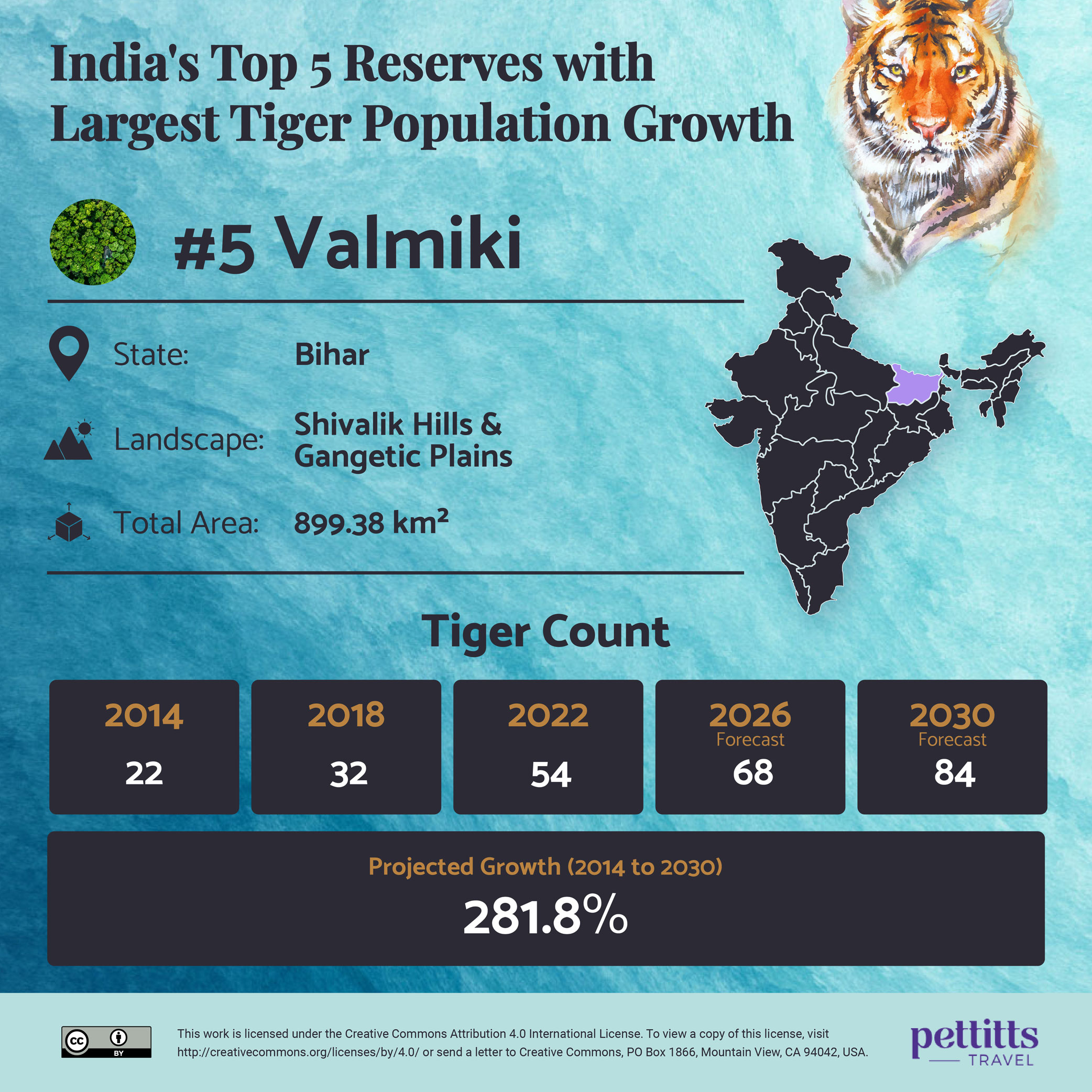
Also located in the Shivalik Hills and Gangetic Plains, Valmiki Tiger Reserve is Bihar’s only tiger reserve and ranks fifth for tiger population growth in India, with numbers projected to rise by 282% between 2014 and 2030.
Its rich biodiversity provides an ideal habitat for tigers, and the reserve offers multi-day safari packages, guided walking trails and watchtowers for spotting deer and wild boar.
The latest 2022 census recorded 54 tigers in the reserve, with numbers forecast to reach 84 by 2030.
Where to See a Tiger in Nepal
Just across the border from India, Nepal’s wildlife is also among the most spectacular in Asia.
The country offers an equally captivating setting to seek out the striking Bengal tiger, alongside other rare animals such as snow leopards, red pandas and more than 850 species of bird.
In July 2026, Nepal’s latest national census recorded 429 wild tigers – three and a half times the 121 counted in 2009.
Nepal is divided into seven provinces, with its tiger national parks spread across four of them.
Pettitts offers a range of luxury wildlife holidays in Nepal, including the Nature and Wildlife of Nepal tour, which showcases the country’s dramatic landscapes, varied climates and an impressive array of species.
Regions in Nepal with the Largest Tiger Population Growth
Nepal is a compact country, covering around 150,000 km2 compared with India’s 3.3 million km2.
While this means there are fewer tigers in Nepal, its provinces and national parks are closer together and easy to combine into a single trip.
Our Journey through Nepal tour blends rich culture and breathtaking natural beauty for a truly memorable escape.
1 Madhesh Province
Madhesh Province is Nepal’s smallest province by area and its most densely populated.
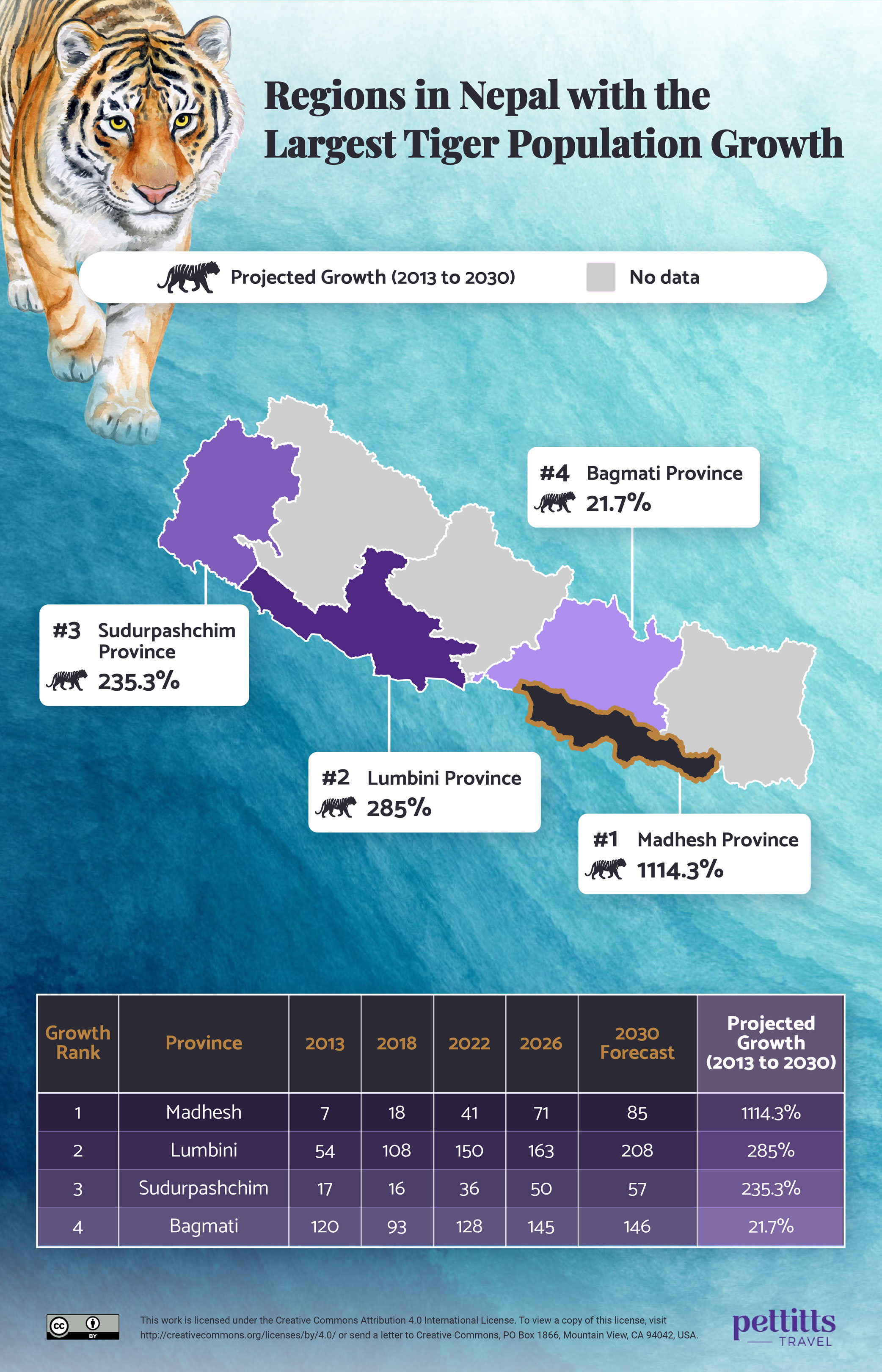
It ranks first for tiger population growth in Nepal, with numbers in its national park projected to rise by a staggering 1,114% between 2013 and 2030.
Its tigers roam Parsa National Park, the province’s main protected area for tigers, where the 2026 census recorded 71 tigers – an impressive rise from just seven in 2013.
Beyond the park, this southern province hosts the historic city of Janakpur, home to the ornate Janaki Mandir temple.
2 Lumbini Province
Lumbini Province lies in western Nepal and is best known for the UNESCO World Heritage Site of Lumbini, the birthplace of the Buddha.
The province is home to two national parks, Bardia and Banke, which together recorded 163 tigers in the 2026 census – the largest tiger population of any province in Nepal.
Lumbini ranks second for tiger population growth, with numbers projected to rise by 285% from 54 in 2013 to 208 by 2030.
3 Sudurpashchim Province
Ranking third for tiger population growth, Sudurpashchim Province lies in the far west of the country, where the Mahakali River forms its border with India.
Its lowlands are home to Shuklaphanta National Park, where the 2026 census recorded 50 tigers roaming its vast grasslands. Tiger numbers here are projected to rise from 17 in 2013 to 57 by 2030, an increase of 235%.
4 Bagmati Province
One of Nepal’s most visited regions, Bagmati Province ranks fourth for tiger population growth. It’s home to Chitwan, Nepal’s first national park, where tiger numbers are projected to rise by 22% between 2013 and 2030.
The 2026 census recorded 145 tigers here – more than any other national park in Nepal and just one short of its 2030 forecast of 146.
Nepal’s capital, Kathmandu, also lies in Bagmati. On our Kathmandu Valley tour, you can explore the magic of the city, from its temples to the valley’s seven UNESCO-listed monument zones.
Nepal’s Top 5 National Parks with the Largest Tiger Population Growth
Most of Nepal’s wild tigers live within five national parks, all located in the Terai Arc Landscape, a cross-border conservation area that runs along the foothills of the Himalayas.
We’ve ranked each park by its projected tiger population growth to help you choose where to begin your search.
1 Banke National Park
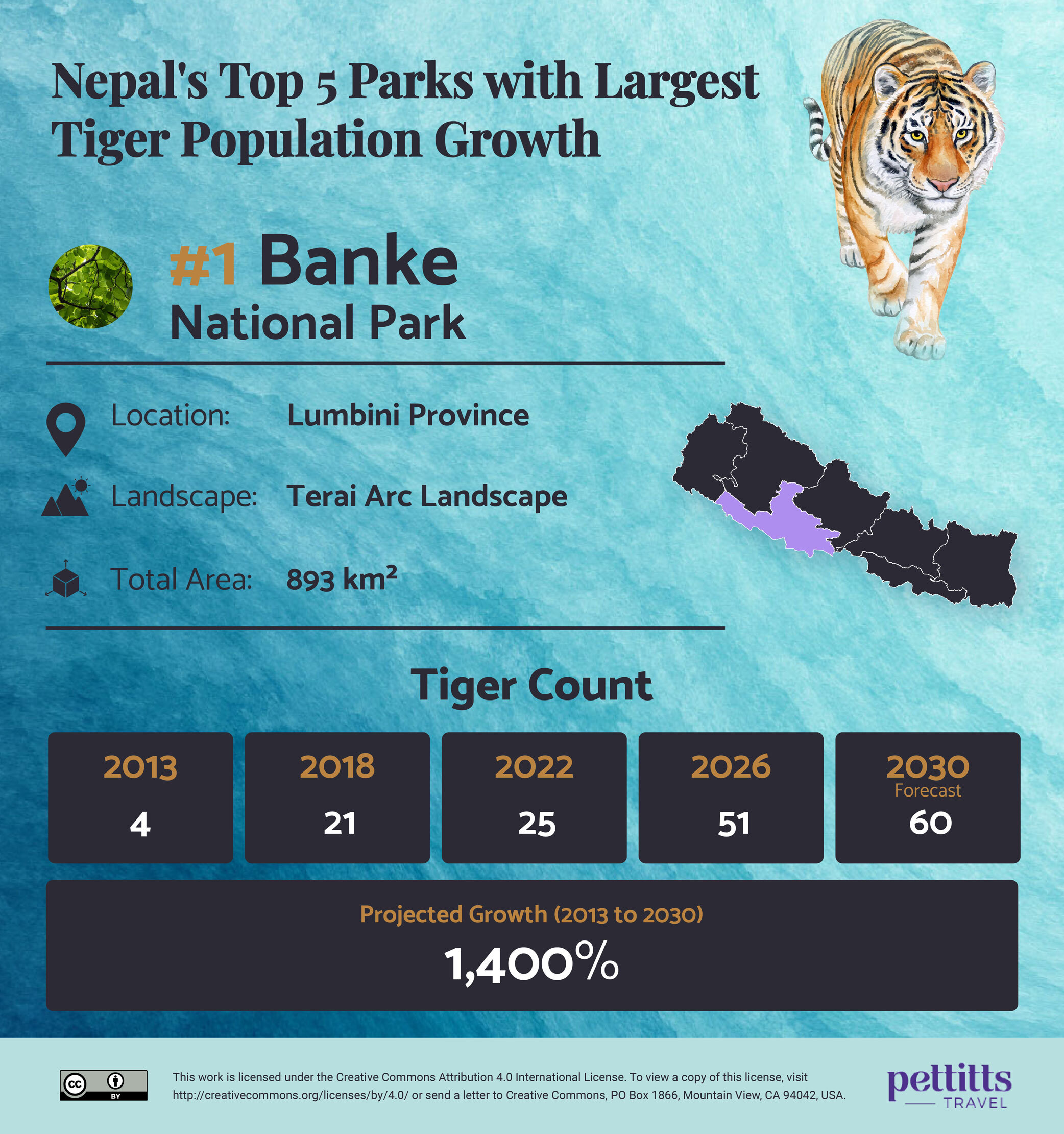
Established in 2010, Banke National Park ranks first for tiger population growth in Nepal.
Its tiger population is forecast to rise by an extraordinary 1,400% between 2013 and 2030.
Located in Lumbini Province, the park offers jeep safaris and guided walks through grasslands and deciduous forests in search of the Bengal tiger. Along the way, keep an eye out for antelope, striped hyenas and Asian elephants.
2 Parsa National Park
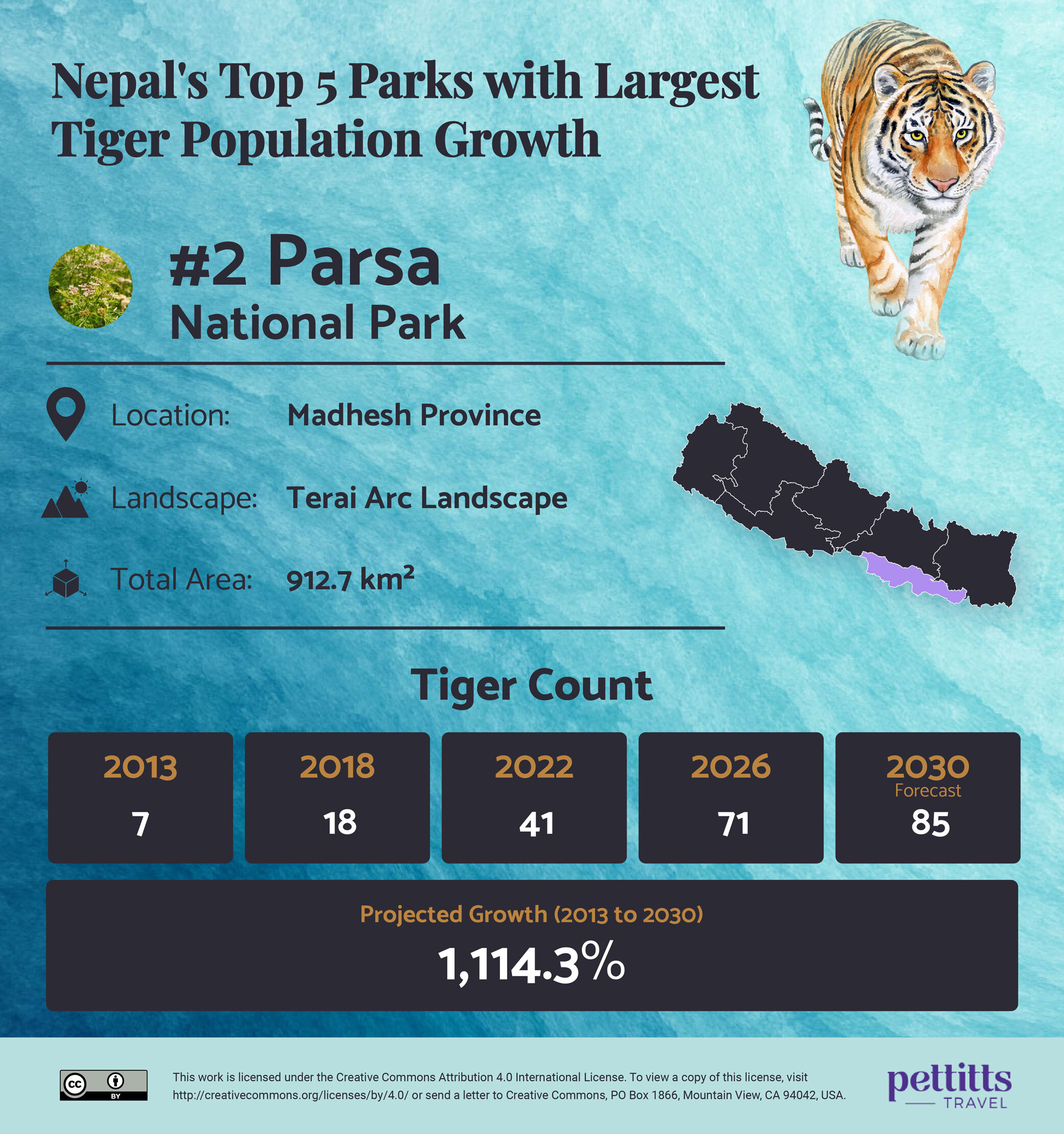
Ranking second for tiger population growth in Nepal, Parsa National Park covers more than 900 km2 of tropical sal forest in Madhesh Province.
Tiger numbers here are projected to rise by 1,114% between 2013 and 2030, with the 2026 census recording 71 tigers in the park.
Jungle safaris and guided walks offer the chance to track the striped big cat, along with leopards, sloth bears and Asian elephants.
3 Shuklaphanta National Park
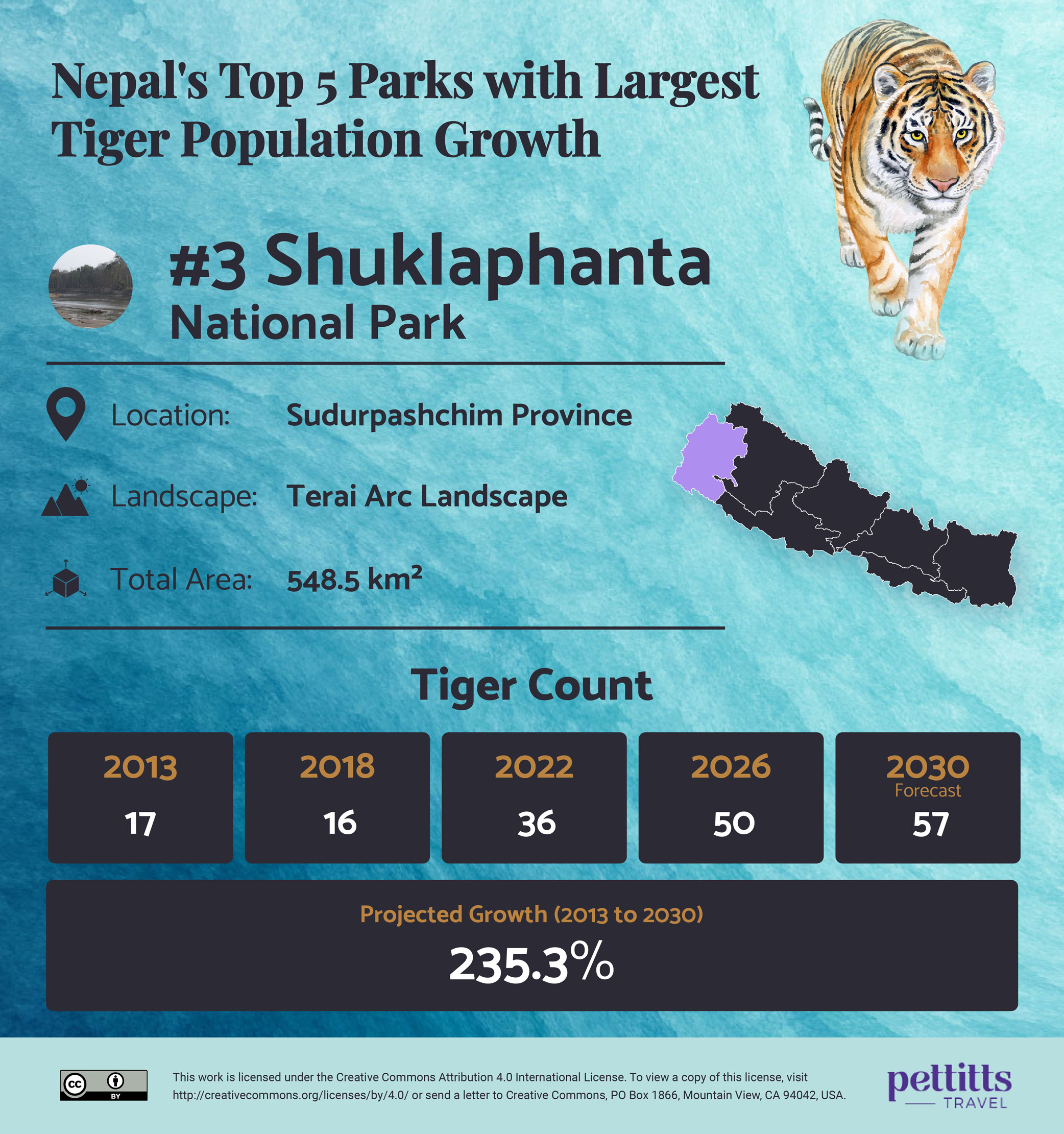
Shuklaphanta National Park ranks third in Nepal for tiger population growth. Here, thrilling safaris can be paired with jungle lodges for a once-in-a-lifetime trip.
As the smallest of Nepal’s five tiger national parks, Shuklaphanta lies in Sudurpashchim Province and spans 549 km2 of grasslands and forests, bordered by the sweeping waters of the Mahakali River. It is also home to mugger crocodiles, cobras and pythons.
The 2026 census recorded 50 tigers in the park, already close to its 2030 forecast of 57 – an increase of 235% from 2013.
4 Bardia National Park
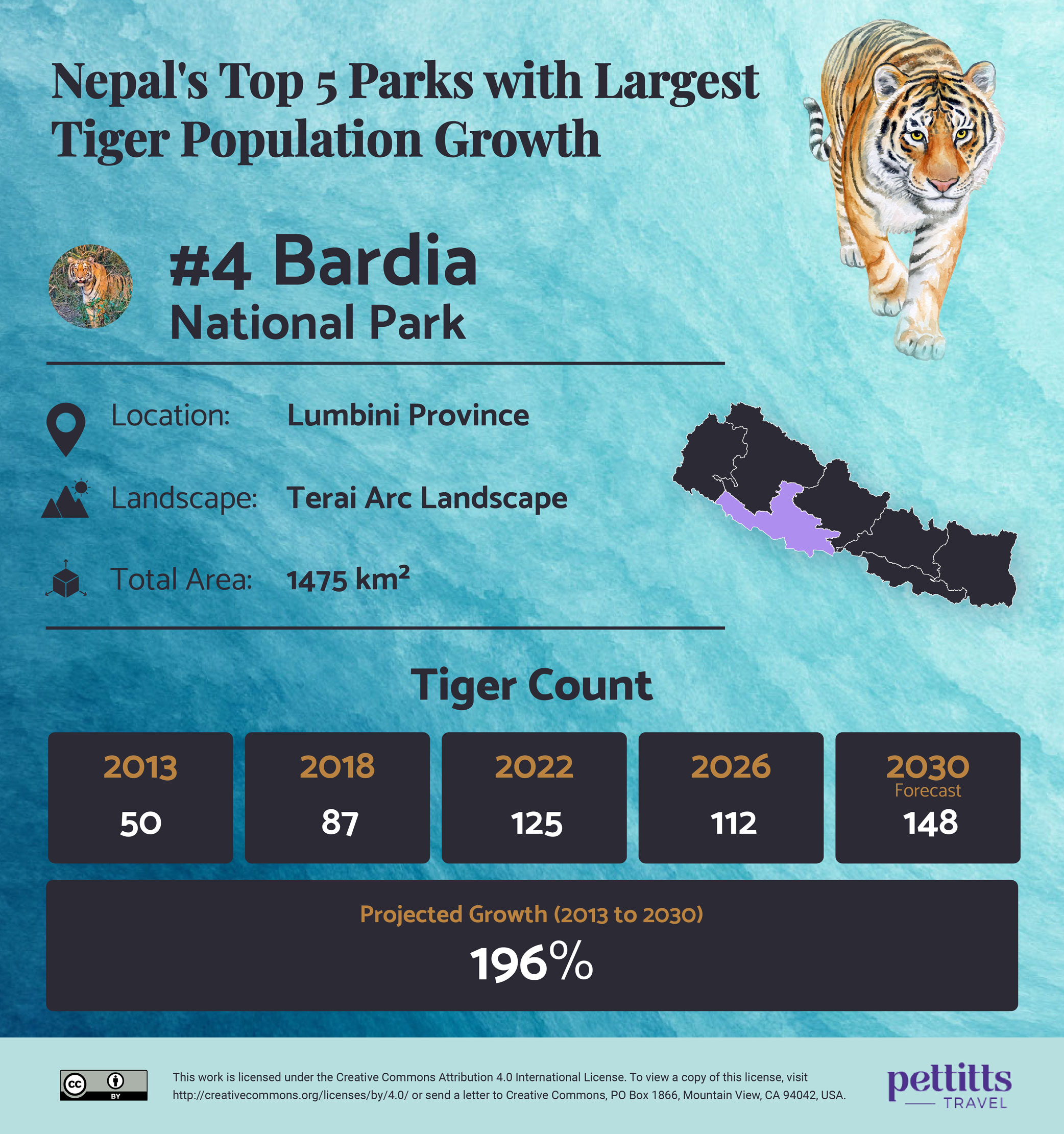
Bardia National Park ranks fourth in Nepal for tiger population growth and is home to more than 30 species of mammals. It currently has the second-largest tiger population in the country.
Located in Lumbini Province, the park recorded 112 tigers in the 2026 census, with numbers projected to reach 148 by 2030 – a 196% increase on 2013.
Alongside jeep safaris through its grasslands and sal forests in search of tigers, you can enjoy boat trips and white-water rafting on the Karnali River for an unforgettable adventure.
5 Chitwan National Park
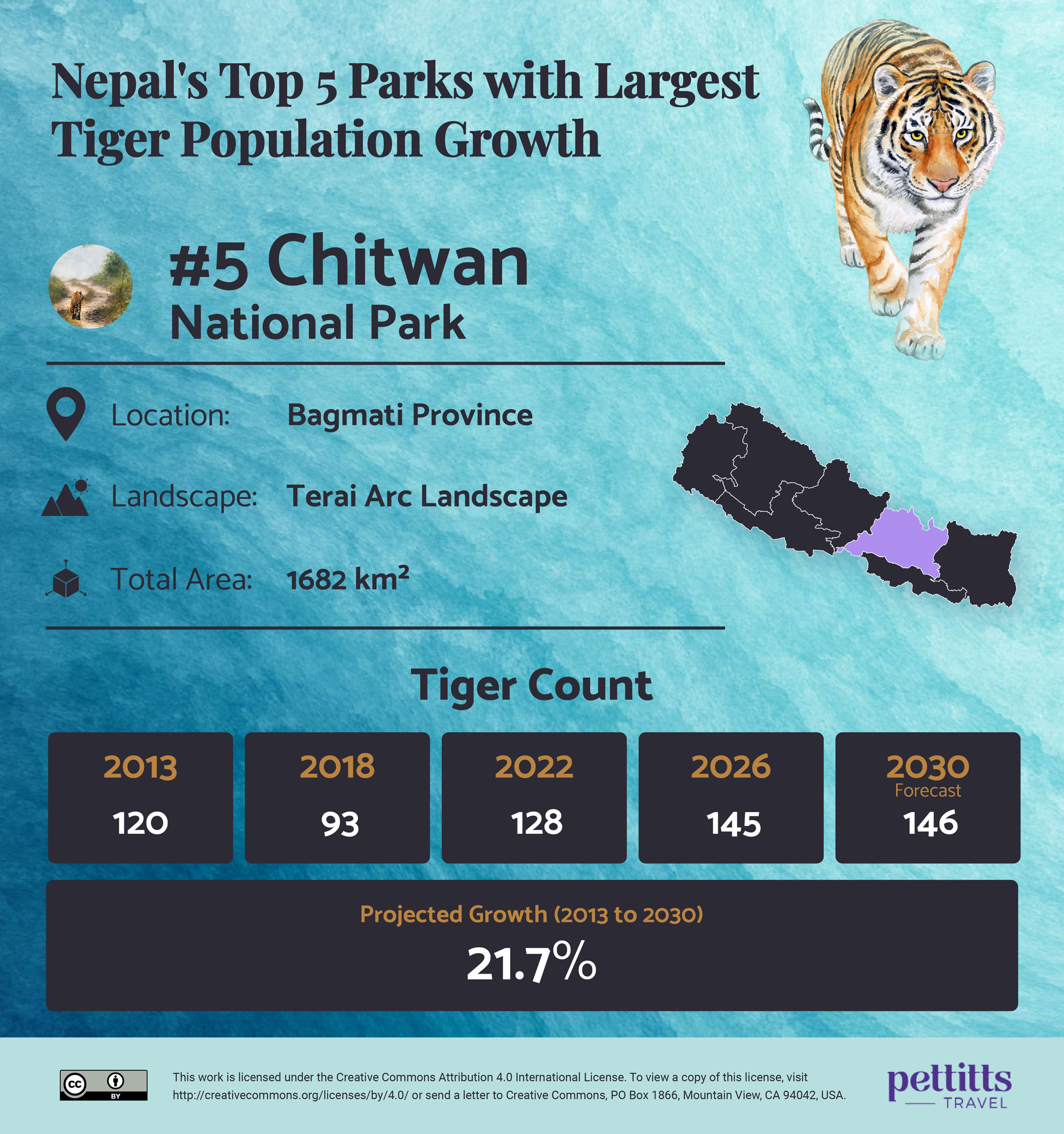
Take a scenic drive or short flight from Kathmandu to Chitwan National Park, a UNESCO World Heritage Site established in 1973 as Nepal’s first national park.
Located in Bagmati Province, Chitwan ranks fifth for tiger population growth in Nepal, with numbers projected to rise by 22% between 2013 and 2030. Yet with 145 tigers recorded in the 2026 census, it is currently home to more tigers than any other national park in the country.
The park offers guided jeep safaris, canoe excursions and nature walks across 1,682 km2 of gorgeous grasslands, wetlands and forests.
Enjoy a Luxury Wildlife Break with Pettitts Travel
We curate luxury wildlife holidays in India and Nepal for travellers who dream of witnessing the Bengal tiger and other remarkable species in their natural habitat.
Our experts also offer tailor-made trips, each one designed around your preferences so you can create memories to cherish for a lifetime.
Methodology
Estimated tiger numbers were taken from the national tiger census reports, conducted roughly every four years and published by the NTCA (India) and NTNC (Nepal). We analysed the last three reports for India, and the last four for Nepal.
We used the figures focused on tigers within 53 India tiger reserves (based on the reserves counted in the 2022 report) and five Nepal national parks where applicable, then combined them to provide regional figures. Nepal’s 2026 figures are taken from census results announced by the Government of Nepal, as the full 2026 NTNC report is not yet available.
The projected figures were predicted using Excel’s forecast function, for 2026 (India only) and 2030, calculated from historical data and using exponential smoothing, which weights recent data more heavily than older data to generate an overall prediction.
The state and province totals are the sum of raw reserve figures, with forecasts based combined totals. National census totals also include tigers outside reserves. Reserves with incomplete data were excluded from the reserve rankings.
Data was sourced in September and October 2026.
Sources:


